Prev6061626364Next
Khamak · 1 year ago
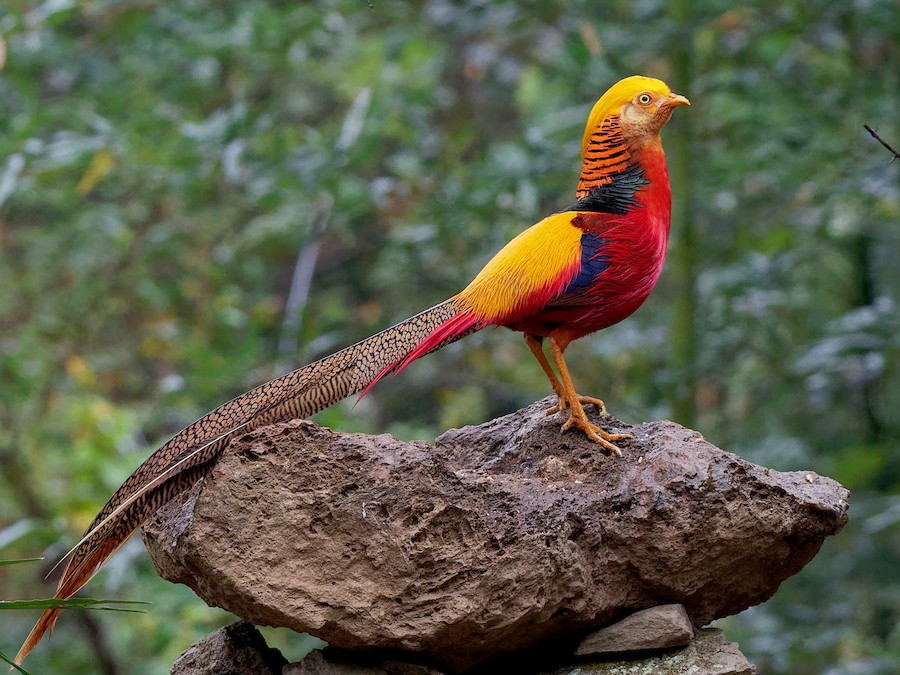
Adult male Golden Pheasant
Shy and surprisingly difficult to find in mixed and conifer woodland, where it runs quickly from detected disturbance. Red-and-gold male stunning and unmistakable. Female differs from Common Pheasant in strongly barred plumage, dull pinkish (not gray) legs and feet and from Lady Amherst’s Pheasant in lighter barring, more orangeish coloration, and the lack of a bare patch of gray skin behind the eye. Native to China but introduced very locally in Britain and Hawaii; however, captive birds might escape anywhere. |
Khamak · 1 year ago
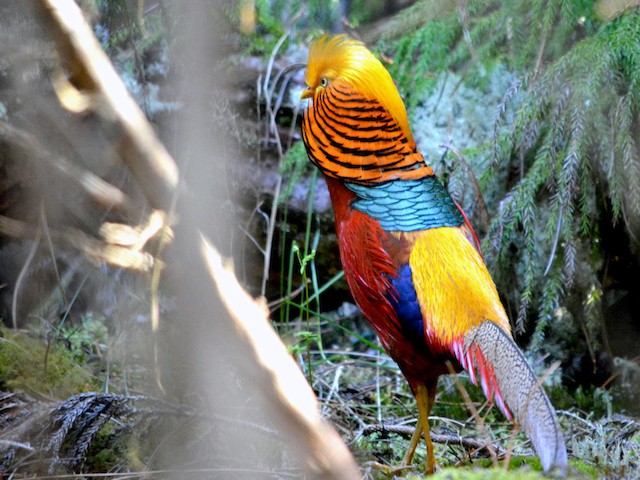
Female Golden Pheasant (Bird)
Shy and surprisingly difficult to find in mixed and conifer woodland, where it runs quickly from detected disturbance. Red-and-gold male stunning and unmistakable. Female differs from Common Pheasant in strongly barred plumage, dull pinkish (not gray) legs and feet and from Lady Amherst’s Pheasant in lighter barring, more orangeish coloration, and the lack of a bare patch of gray skin behind the eye. Native to China but introduced very locally in Britain and Hawaii; however, captive birds might escape anywhere. |
Khamak · 1 year ago
Adult male Golden Pheasant (Bird)
Shy and surprisingly difficult to find in mixed and conifer woodland, where it runs quickly from detected disturbance. Red-and-gold male stunning and unmistakable. Female differs from Common Pheasant in strongly barred plumage, dull pinkish (not gray) legs and feet and from Lady Amherst’s Pheasant in lighter barring, more orangeish coloration, and the lack of a bare patch of gray skin behind the eye. Native to China but introduced very locally in Britain and Hawaii; however, captive birds might escape anywhere. |
Dilpat · 1 year ago
Chupacabra
The chupacabra or chupacabras (Spanish pronunciation: [tʃupaˈkaβɾas], literally 'goat-sucker', from Spanish: chupa, 'sucks', and cabras, 'goats') is a legendary creature, or cryptid, in the folklore of parts of the Americas. The name comes from the animal's purported vampirism—the chupacabra is said to attack and drink the blood of livestock, including goats. |
Dilpat · 1 year ago
Lioness and cubs in Kruger National Park
Unlike Cape Town (with its Mediterranean climate), the climate of Kruger National Park is subtropical, with distinct wet and dry seasons. By day, it is warm to hot year-round. Although it is a year-round destination for safaris, the seasons greatly impact wildlife viewing. The rainy season—October through April—equates to the hot and humid summer months (winter in the northern hemisphere). The dry season (May through September) is winter, with warm and mild days, and chilly nights and early mornings. |
Dilpat · 1 year ago
Visiting Kruger in Winter/Dry Season (June-August) / Rhino during the dry season
Although the dry season extends from May through October, the driest period is in the cool mid-winter months. Temperatures are at their most pleasant, with warm days, low humidity, and virtually no rainfall. Mid-day temperatures average a very pleasant 79°F (26°C) in mid-winter, with deep-blue cloudless skies. However, nighttime temperatures fall dramatically. Early morning temperatures just before sunrise average about 50°F (10°C), and are often much colder. |
Dilpat · 1 year ago
Cape buffalo during the wet season
By November the mercury soars, the humidity rises exponentially as the rainy season sets in, and mosquitoes are more prevalent. The summer months can be uncomfortably hot: daytime high temperatures average 90°F (32°C) and can peak well above 100 °F (38 °C), while your clothes will stick to your body in the muggy air. Late afternoons and evenings often bring dramatic thunderstorms—especially in December-February, the hottest and wettest months. However, it rarely rains all day and mornings are usually clear. This is a season to laze away the mid-day hours in the relative comfort of your lodge or camp (in summer, we recommend staying at an air-conditioned lodge, as camping requires a high degree of tolerance for heat and rain). |
Dilpat · 1 year ago
House Wren (Bird)
In late April through early May, house wrens return to their breeding range and start their first brood. The male house wren arrives first and marks its territory by building crude dummy nests. Wrens nest in natural cavities and human-made nest boxes, as well as any crevice they can find, such as old boots, abandoned hornet nests, or farm machinery. The female completes the nest construction at one of the dummy nest sites. She will lay one egg per day until she has a clutch size of 5-8 eggs. Incubation is by the female only and lasts for 12–13 days, depending on the temperature. The hatchlings fledge at about 17 days, and parental care continues for another 13 days. |
Prev426427428429430431432...601Next