The site tips.wapka.site
T I P S
Albums Category Messages |||
Agra Fort
Anila · 3 months ago
Agra Fort
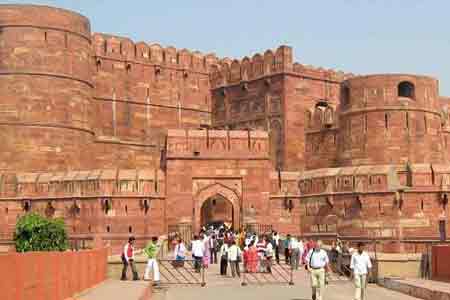
A gra Fort is located (270 10’ 47’’N & 780 1’ 22’’ E) on the right bank of the river Yamuna in the city of Agra in Uttar Pradesh. It is one of the most important and robustly built stronghold of the Mughals, embellished with number of richly decorated buildings encompassing the imposing Mughal style of art and architecture. It was constructed by the third Mughal emperor Akbar on the remains of an ancient site known as Badalgarh. Sikandar Lodi (1487-1517) was the first Sultan of Delhi to shift his capital from Delhi to Agra. After Sikandar Lodi who died in 1517, his son Ibrahim Lodi held the fort for 9 years until he was defeated and killed in the battle of Panipat in 1526. Several palaces, wells and a mosque were built in the fort during the Lodi period.

When Babur sent his son Humayun to Agra, he captured the fort and seized a vast treasure, which included the world famous ‘Koh-i-noor’ diamond as well. Babur built a baoli (step-wall) here. Humayun was coronated here in 1530. Nazam, a water-carrier (saqqa), who had saved Humayun from drowning, was crowned here as an emperor for half-a-day. After Humayun’s defeat at Bilgram in 1540, Sher Shah of the Sur dynasty occupied Agra fort and garrisoned it.

Akbar arrived in Agra in 1558. He ordered to renovate the fort with red sandstone. Some 4000 builders daily worked on it and it was completed in 8 years (1565-1573). The fort, semi-circular on plan, is surrounded by a 21.4 m high fortification wall. Double ramparts have been provided here with broad massive circular bastions at regular intervals. There are four gates on its four sides, one of the gates was called “khizri-gate” (the water gate) which opens to the river front, where ghats (quays) were provided .The fort has survived through the onslaught of time, nature and men. The fort spreads over an area of about 94 acres of land. At present, there exist more than two dozens of monuments in the Fort.
Agra fort, a UNESCO World Heritage Site is still preserved in fine form. Agra Fort a beautiful and unique blend of Muslim and Hindu architecture. There are many remarkable designs and houses inside the fort. The Fort is a colossal semicircular form with Yamuna River flowing on the east. The course of the river has changed over the years and has drifted further from the fort. The walls are 70 ft high and are surrounded by moat which were again crossed only by drawbridge.

The famed peacock throne was once kept here at the Deewan-i-Am. The Fort has some interesting sites like Jahangir's Palace, Anguri Bagh garden, Diwan-e-Khas and the beautiful Musamman Burj built by Shah Jahan for his wife. The marble palace offers a great view of Taj Mahal tajmahal. It was here that he spent the last part of his life under house arrest. A visit to Agra Fort would be a great experience for art and history lovers. It offers a good visual treat of the bygone eras; a peek into another world we have heard only in tales from our history books.
Anila · 3 months ago
Published on 2025-10-27 16:30:03
ID NUMBER: 135357
Agra Tourism (0)

Edit Report Send Share
Anila · 3 months ago
Taj Mahal Agra
The TajMahal is an integrated complex of structures that include a white marble mausoleum containing the tombs of the Mughal emperor Shah Jahan (1592 - 1666) and his third wife Mumtaz Mahal (1593-1631). The Mughal dynasty built many mausoleums in the Indian subcontinent but the Taj Mahal is undoubtedly the finest. The mausoleum is built entirely of white marble, set on a high base or plinth which includes four tall minarets, one on each corner. On either side of the tomb are a mosque and a guest house, while the tomb faces a garden laid out in the "charbagh" style, with a central walkway with fountains and viewing platforms with green spaces and trees on either side. The entrance to the complex is through a grand ornamental gateway, inscribed with Quranic inscriptions and the calligraphed line "O Soul, thou art at rest. Return to the Lord at peace with Him, and He at peace with you."

Taj Mahal, synonymous with India’s identity, is the crowning jewel of Mughal architecture in India. The Mughal tradition of erecting majestic mausoleums in memory of Royal members found its culmination in the Taj’s majestic form. The Humayun’s tomb built in 1562 was a major influence over Taj’s design. An architectural marvel, the structure incorporates elements of Persian influences like the design of the Dome and incorporation of arched entrances or ‘Iwans’ along with inspiration from contemporary Hindu design elements like chhatris and copious incorporation of the lotus motif. Described by Tagore as “the tear-drop on the cheek of time”, the monument embodies funereal austerity turned into the most beautiful reminder of eternal love.
Taj Mahal is part of an elaborate complex consisting of a decorative gateway, a beautifully designed garden, a wonderful water system and a mosque. The complex is situated on the southern banks of river Yamuna. The complex stretches in a south to north incline towards the river and is constructed in steps.
Anila · 3 months ago
Fatehpur Sikri
Fatehpur Sikri is an abandoned city in Agra. The city was held as the capital of Mughal Empire during 16th century and was abandoned within a decade or two. Fatehpur Sikri means Victorious city. It was built as a symbol of Akbar’s victories during the period. Today, it stands as an interesting reminder of Mughal architecture. You can also find Jain temples inside the walled city, which indicates the growth of Jainism during Mughal reign. During an archaeological survey in 2000, many antiques, statues and structures that are more than 1000 years old were evacuated. Many Jain statues were a part of the evacuation. Today, it stands as a heritage site and a reminder of ancient India’s architecture, culture and lifestyle. 

The great emperor Akbar had no heir. He visited many places offering prayers and seeking blessings of saints. On one such endeavor he was blessed by a Sufi Saint Sheikh Salim Chishti in the village Sikri and the saint foretold that the emperor will be blessed with a son. After birth of his son the emperor showed his gratitude by building a city in the honor of the Sufi Saint and named it Fatehpur Sikri. "Fateh" in Persian language means "victory".

The city is about 37 km from Agra on the Sikri ridge 3 km in length and 1km wide surrounded by wall covering three sides and a lake on the fourth side. Akbar conceptualized to build the walled city which took around fifteen years to complete and includes royal palaces, private quarters, harems, different utility buildings, court and mosques. Tuhir Das, the architect of the city primarily used Indian principles which includes use of various regional schools of art and craftsmanship specially that of Bengal and Gujarat. Apart from Islamic elements, significance was given to Hindu and Jain architecture. Akbar shifted his capital from Agra to Fatehpur Sikri. Number of gates was built to approach the city namely Delhi Gate, Agra Gate, Lal Gate, Birbal's Gate, Gwalior Gate, Tehra Gate, Chandanpal Gate, Chor Gate and Ajmere Gate. After the death of the Sufi saint, Akbar erected a Tomb of the saint made of red Sandstone. It is this city that gave birth to the legends of the great Akbar and his famed courtiers known as "Navratnas" or the nine jewels.

Persian principles are highly reflected in the complex as Akbar wished to revive magnificence of Persian court ceremonial as was during the time of his famous ancestor Timur. Local abundance of red sandstone was fully utilized in constructing the structures and buildings. The royal palace complex consist series of individual pavilions that were beautifully arranged in geometric patterns inspired from Arabian and central Asian encampments and rests on a piece of level ground. The monuments and structures in Fatehpur Sikri remind one about artistic sense and the holistic approach of the great emperor. Influence of Indian embellishments is highly represented.
Due to shortage of water availability the palatial complex was abandoned by Akbar just after its completion in 1585. The presence of nearby Rajputana areas in the North West and the increasing turmoil also caused shifting of the emperor's base from Fatehpur Sikri to Lahore and thereafter again to Agra in 1598.
Anila · 3 months ago
Agra Fort
A gra Fort is located (270 10’ 47’’N & 780 1’ 22’’ E) on the right bank of the river Yamuna in the city of Agra in Uttar Pradesh. It is one of the most important and robustly built stronghold of the Mughals, embellished with number of richly decorated buildings encompassing the imposing Mughal style of art and architecture. It was constructed by the third Mughal emperor Akbar on the remains of an ancient site known as Badalgarh. Sikandar Lodi (1487-1517) was the first Sultan of Delhi to shift his capital from Delhi to Agra. After Sikandar Lodi who died in 1517, his son Ibrahim Lodi held the fort for 9 years until he was defeated and killed in the battle of Panipat in 1526. Several palaces, wells and a mosque were built in the fort during the Lodi period.

When Babur sent his son Humayun to Agra, he captured the fort and seized a vast treasure, which included the world famous ‘Koh-i-noor’ diamond as well. Babur built a baoli (step-wall) here. Humayun was coronated here in 1530. Nazam, a water-carrier (saqqa), who had saved Humayun from drowning, was crowned here as an emperor for half-a-day. After Humayun’s defeat at Bilgram in 1540, Sher Shah of the Sur dynasty occupied Agra fort and garrisoned it.

Akbar arrived in Agra in 1558. He ordered to renovate the fort with red sandstone. Some 4000 builders daily worked on it and it was completed in 8 years (1565-1573). The fort, semi-circular on plan, is surrounded by a 21.4 m high fortification wall. Double ramparts have been provided here with broad massive circular bastions at regular intervals. There are four gates on its four sides, one of the gates was called “khizri-gate” (the water gate) which opens to the river front, where ghats (quays) were provided .The fort has survived through the onslaught of time, nature and men. The fort spreads over an area of about 94 acres of land. At present, there exist more than two dozens of monuments in the Fort.
Agra fort, a UNESCO World Heritage Site is still preserved in fine form. Agra Fort a beautiful and unique blend of Muslim and Hindu architecture. There are many remarkable designs and houses inside the fort. The Fort is a colossal semicircular form with Yamuna River flowing on the east. The course of the river has changed over the years and has drifted further from the fort. The walls are 70 ft high and are surrounded by moat which were again crossed only by drawbridge.

The famed peacock throne was once kept here at the Deewan-i-Am. The Fort has some interesting sites like Jahangir's Palace, Anguri Bagh garden, Diwan-e-Khas and the beautiful Musamman Burj built by Shah Jahan for his wife. The marble palace offers a great view of Taj Mahal tajmahal. It was here that he spent the last part of his life under house arrest. A visit to Agra Fort would be a great experience for art and history lovers. It offers a good visual treat of the bygone eras; a peek into another world we have heard only in tales from our history books.
Anila · 3 months ago
Itimad ud Daulah Tomb
Tomb of I'timād-ud-Daulah is a Mughal mausoleum in the city of Agra in the Indian state of Uttar Pradesh. Often described as a "jewel box", sometimes called the "Baby Tāj", the tomb of I'timād-ud-Daulah is often regarded as a draft of the TājMahal. Along with the main building, the structure consists of numerous outbuildings and gardens. The mausoleum was commissioned by Nūr Jahān, the wife of Jahangir, for her father Mirzā Ghiyās Beg, originally a Persian Amir in exile, who had been given the title of I'timād-ud-Daulah (pillar of the state). 

This tomb, built in the famed Char Bagh style is not a very large structure. The main chamber of Itmad ud Daulah is richly decorated with mosaics and semi precious stones inlaid in the white marble. The theme of wine flask with snakes as handles is a recurring one on the engraved walls of this chamber. The marble screens of geometric lattice work allows some gentle lighting.
The Tomb of Itmad ud Daulah was built by Nur Jahan, wife of Jahangir, for her father Mirza Ghiyas-ud-din. This tomb in Agra is believed to have inspired the design of Taj Mahal. Ghiyas-ud-din died in 1622 and Nur Jahan built this mausoleum for her father. The tomb of Itmad ud Daulah is built entirely of white marble.
Anila · 3 months ago
Jama Masjid Agra
The Jama Masjid of Agra or "Jami Masjid" as it is also known was built by Shah Jahan in 1648 for his daughter Princess Jahanara Begum. Located near the Delhi Gate of the Agra Fort, it is said that construction of the masjid was completed in almost six years using almost 5,000 workers! The mosque is a sight to behold and is a must-see on any visit to Agra. Delicate architecture
The Buland Darwaza is the grand entrance which leads to the Jama Masjid. The mosque is placed on an elevated platform with five major entrances into its main praying area. Many walls within the mosque feature delicate carvings and inscriptions from the Quran, the holy book of Islam. The exterior of the mosque is done mainly in red sandstone with some amount of detailing in white marble. The central courtyard of the mosque is fairly large and accommodates a very large number of devotees during prayer times.

History
Emperor Shah Jahan, the great king of the Mughal dynasty, is credited with constructing lots of beautiful structures in and around Agra. The Tajmahal is the most prominent of them all. The next beautiful structure is the Jama Masjid. This mosque was built by the Emperor in 1648 and bears slight resemblances to the magic made out of marble, the Taj Mahal. Red sandstone is the basic raw material used in the construction of this mosque. It took 6 years for the mosque to get constructed. Close to 5000 workers were involved in the construction of the Jama Masjid. When it was constructed in 1648, the Jama Masjid had a massive open area in the front, known as the Tripolia Chowk, between the Jama Masjid and Agra Fort’s Delhi Gate. However, in the period between 1871 and 1873, this Chowk was destroyed in order to give room for the Agra Fort Railway station. During those days, Islamic scholars were so spellbound by the beauty of this Jama Masjid that they compared it with the great Baitul – Mamur, a scintillating mosque in the fourth sky made from rubies and pearls.
Anila · 3 months ago
Akbar's Tomb
Akbar’s Tomb (Sikandra Tomb) is one of not to be missed attractions on Agra sightseeing tours in India. It is a beautiful tomb monument situated in approx. 119 acres of grounds in Sikandra, an important suburb of Agra city in Uttar Pradesh, India. It is a tomb of the great Mughal Emperor Akbar, and regarded as an important Mughal architectural masterpiece. This beautiful mausoleum monument was constructed in 1605 - 1613 by his son prince Salim later called Jahangir. The planning of the tomb and site for the tomb was made by Akbar himself. After his death, his son Salim (Jahangir) completed the construction. 

The architecture of the Akbar’s Tomb is magnificent and appealing. It is considered to be as very important Mughal architectural masterpiece because of its beauty and decoration work. The largest gate to the tomb complex is the South Gate with four beautiful white marble chhatri topped minarets. Minarets are similar to those of the Taj Mahal. Tajmahal The South Gate is the main and normal entry point to the tomb. The entire tomb complex is ornamented in beautiful geometrical, floral and calligraphic designs.

Akbar was the Mughal emperor from 1556 till his death in 1605. According to the tradition of Tartary, one could construct his own tomb during his lifetime. This custom was religiously followed by the Mughals. Akbar had chosen a suitable site at Sikandra, an area close to Agra city named after Sikandar Lodhi. His son Jehangir completed the monument after Akbar's death, building the topmost storey using white marble.

The tomb, shaped like a truncated pyramid, is a five-storey building resting on a high stone platform. It is located right in the center of a square piece of land with four causeways extending from it in four directions. The magnificent entrance, the fine patterns, the jali work, all are inspired from Islamic style, while the calligraphy and the layout of the garden famously known as Charbagh speaks of the Persian style. The use of canopies, airy pavilions in tiers, and the absence of a dome show influence of the local architecture.

The south gate leads to the Akbar tomb through the garden. Floral and geometrical arabesque embellishments in white decorate the gateway, along with splendidly adorned calligraphy. The corners of the monument are beautified with minarets of white marble. The four causeways and gardens lead to the main tomb. Arcaded verandas with cloisters and several cubicles are there in all the square stories of the tomb. Some of the cubicles in the second storey have pyramidal roofs, while others are adorned with cupolas. In the third storey there is a square room in each segment. The top storey has an open square court encircled with slender arches and piers with delicate marble screens as walls. The false cenotaph of the emperor, adorned with arabesque and floral pattern carvings, is laid on a square platform placed at the center of the courtyard. The entire storey is built of white marble.
Anila · 3 months ago
Moti Masjid
Moti Masjid was built by the Mughal Emperor Shah Jahan during 1648-54 AD. It was built as a place of worship for the royal members of the court. A mosque that shines like a pearl in a moonlit night, hence the name Pearl Mosque, Moti Masjid is one of the oldest mosques in the city. The glorious mosque took nearly four years to complete and is built in a style that is typical to Shah Jahan's era of reign.

The masjid stands on the ground that slopes from east to west to the north of Diwan-i-Am complex. The structure contains three huge domes of high architecture value. These three Hindu style domed kiosks have been constructed using white marble and the rest of the exterior building made out of red sandstone. The mosque has twenty-one bays of which three have vaulted soffits. In t2he center of the court of the mosque, a marble tank is situated and a sundial made on an octagonal marble pillar standing in one corner. The western wall has an inlaid mihrab that is beautifully carved with six niches corresponding to the arches. The main prayer chamber has lattice screens made of marble on either side to separate the portions from the main chamber hall. These portions were used by women to offer their prayers. Above the parapet there are seven chhatris beautifully designed with an octagonal tower along with domed shape marble structures at each corner.

The Moti Masjid was built by Mughal Emperor Shah Jahan as a place of worship for the royal members of the court. The architectural features of the Mosque bear remarkable resemblance to that of the St. Basils Cathedral in Moscow. The mosque built between 1648 and 1654 is situated to the right of the Diwan-E-Aam or the hall where the Emperor held darbar for the common man. The ground where the masjid stands slopes from east to west to north of Diwan-E Aam complex. The three domes of the mosque built of white marbles, resting on the red sandstone walls looks magnificent and one can observe the splendid symmetrical design that is formed. Along the parapet, a series of domed kiosks are built that are designed after Hindu architecture. Supported by piers and lobed arches, seven bays are there that are divided into aisles. In the center of the court of the mosque, a marble tank is situated and a sundial made on an octagonal marble pillar standing in one corner gives quite an interesting and intriguing look. The prayer chamber is placed on the western side while the northern, eastern and southern sides are surrounded by arcaded cloisters with twelve sided pillars and beautifully cusped arches.

There are three gates to the mosque, the main and largest entrance being the one in the eastern side as also the most beautiful one. The other two subsidiary gates are on the northern and southern sides. Arches and three square chatris crowning the gates give them a royal look. The main gateways are built of red sandstone exterior and marble interior and can be approached by two staircases. An arcade of seven arches is there in the prayer chamber. A total of twenty-one bays are there of which only three have vaulted soffits. The western wall has an inlaid mirhab that is beautifully carved with six niches corresponding to the arches. The main prayer chamber has latticework screen made of marble on either side to separate the portions from the main chamber hall. These portions were used by women to offer their prayers. Above the parapet there are seven chatris beautifully designed and square in shape with an octagonal tower with domed shape marble structures at each corner. Unlike the usual case where the pulpit can be reached by climbing three steps, the pulpit of this Masjid has four steps.
Anila · 3 months ago
Mehtab Bagh Agra
Mehtab Bagh, the moonlit garden, grew just across the northern waterfront of Yamuna when the Taj Mahal tajmahal was built on its south bank in Uttar pradesh. This place was once a heavenly garden with shaded pavilions, fountain jets, fragrant flowers and fantastic pools. But gradually the site became desolate. This site has now turned in to an epicenter for the project to establish protective green around the Taj Mahal. The interest in Mehtab Bagh has developed again recently due to the increasing concern for the Taj Mahal. Its grounds are facing a great threat due to too many tourists. 

Mehtab Bagh is a 25 acre garden, square in shape, measures about 300 x 300 m and is perfectly aligned with the Taj Mahal on the opposite bank. During the rainy season, the ground becomes partially flooded. The garden has fountains and pools along with several pavilions. Few of the gardens proportions were similar to that of the Taj Mahal. Mehtab Bagh came later in the possession of King of Amber, Raja Man Singh Kacchawa. Mehtab Bagh also joins two other gardens to the west. Originally, four sandstone towers marked the corners of Mehtab Bagh of which only one at the south east edge remains. The gardens also contain a large pond on its outer edges which reflects the image of the Taj. Apart from water channels that enhance the beauty of the park, there is also a small tank in the center of the garden.

The garden was ruined by frequent floods. Most of the damaged part was taken by villagers to use as building materials. The structures that remained within the garden are not maintained properly. ASI started some restoration in the 1990s. Recent excavations conducted by ASI revealed a huge octagonal tank equipped with 25 fountains on the southern periphery, a small central tank and a pavilion on the east. It is also known as the Moonlight garden as one can enjoy a spectacular night view of Taj Mahal on full moon day from here.
Anila · 3 months ago
Agra Fort
A gra Fort is located (270 10’ 47’’N & 780 1’ 22’’ E) on the right bank of the river Yamuna in the city of Agra in Uttar Pradesh. It is one of the most important and robustly built stronghold of the Mughals, embellished with number of richly decorated buildings encompassing the imposing Mughal style of art and architecture. It was constructed by the third Mughal emperor Akbar on the remains of an ancient site known as Badalgarh. Sikandar Lodi (1487-1517) was the first Sultan of Delhi to shift his capital from Delhi to Agra. After Sikandar Lodi who died in 1517, his son Ibrahim Lodi held the fort for 9 years until he was defeated and killed in the battle of Panipat in 1526. Several palaces, wells and a mosque were built in the fort during the Lodi period.

When Babur sent his son Humayun to Agra, he captured the fort and seized a vast treasure, which included the world famous ‘Koh-i-noor’ diamond as well. Babur built a baoli (step-wall) here. Humayun was coronated here in 1530. Nazam, a water-carrier (saqqa), who had saved Humayun from drowning, was crowned here as an emperor for half-a-day. After Humayun’s defeat at Bilgram in 1540, Sher Shah of the Sur dynasty occupied Agra fort and garrisoned it.

Akbar arrived in Agra in 1558. He ordered to renovate the fort with red sandstone. Some 4000 builders daily worked on it and it was completed in 8 years (1565-1573). The fort, semi-circular on plan, is surrounded by a 21.4 m high fortification wall. Double ramparts have been provided here with broad massive circular bastions at regular intervals. There are four gates on its four sides, one of the gates was called “khizri-gate” (the water gate) which opens to the river front, where ghats (quays) were provided .The fort has survived through the onslaught of time, nature and men. The fort spreads over an area of about 94 acres of land. At present, there exist more than two dozens of monuments in the Fort.
Agra fort, a UNESCO World Heritage Site is still preserved in fine form. Agra Fort a beautiful and unique blend of Muslim and Hindu architecture. There are many remarkable designs and houses inside the fort. The Fort is a colossal semicircular form with Yamuna River flowing on the east. The course of the river has changed over the years and has drifted further from the fort. The walls are 70 ft high and are surrounded by moat which were again crossed only by drawbridge.

The famed peacock throne was once kept here at the Deewan-i-Am. The Fort has some interesting sites like Jahangir's Palace, Anguri Bagh garden, Diwan-e-Khas and the beautiful Musamman Burj built by Shah Jahan for his wife. The marble palace offers a great view of Taj Mahal tajmahal. It was here that he spent the last part of his life under house arrest. A visit to Agra Fort would be a great experience for art and history lovers. It offers a good visual treat of the bygone eras; a peek into another world we have heard only in tales from our history books.
Agra Tour Packages (6)
Agra Tourism (8)
Agra Fort
Albums Category Members Messages
Login
HELP CENTER :-: GO TO TOP
tips.wapka.site
Copyright © 2026 All Rights Reserved
Powered by wapka.org