The site tips.wapka.site
T  I  P  S 
Mallard (Anas platyrhynchos)
Information · 2 years ago
Mallard (Anas platyrhynchos)
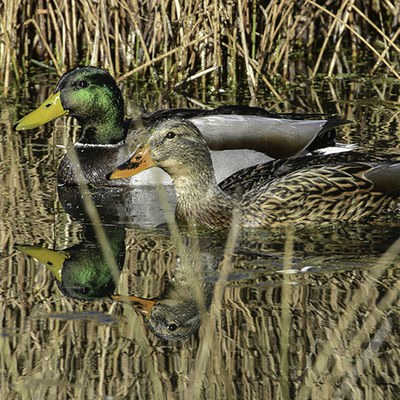
These are the quintessential duck, taking the rank as the most abundant duck in the world. The mallard is the ancestor to most domesticated breeds of ducks and can be found in nearly every town in North America.

Males and females have distinct differences in their plumage displays; males having a glossy green head, white ring on neck, brown chest, black rear, and yellow bill, and females have a more muted plumage display of mottled brown with an orangish brown bill. Both sexes have a vibrant blue stripe or “speculum” on their wings. Other than coloration, males’ and females’ size and appearance is very similar; approximately two feet in length, two to three pounds, and having flat wide bills.

Mallards are known as dabbling ducks—they feed underwater by tipping forward and grazing. What makes these ducks so prevalent is their adaptability to almost any wetland environment and their wide range of preferred food sources. Mallards are omnivores and will eat seeds, stems, roots, insects, mollusks, tadpoles, frogs, earthworms, small fish, etc.
Information · 2 years ago
Published on 2024-12-28 13:43:33
ID NUMBER: 127896
Ducks of Central Oregon (Mijan) (0)
  • Information · 2 years ago

    Mallard (Anas platyrhynchos)

    These are the quintessential duck, taking the rank as the most abundant duck in the world. The mallard is the ancestor to most domesticated breeds of ducks and can be found in nearly every town in North America.
    
    Males and females have distinct differences in their plumage displays; males having a glossy green head, white ring on neck, brown chest, black rear, and yellow bill, and females have a more muted plumage display of mottled brown with an orangish brown bill. Both sexes have a vibrant blue stripe or “speculum” on their wings. Other than coloration, males’ and females’ size and appearance is very similar; approximately two feet in length, two to three pounds, and having flat wide bills.
    
    Mallards are known as dabbling ducks—they feed underwater by tipping forward and grazing. What makes these ducks so prevalent is their adaptability to almost any wetland environment and their wide range of preferred food sources. Mallards are omnivores and will eat seeds, stems, roots, insects, mollusks, tadpoles, frogs, earthworms, small fish, etc.

    Information · 2 years ago

    Common Goldeneye (Bucephala Clangula)

    The common goldeneye is called so (quite obviously) because of its strikingly amber eye that is accentuated by its glistening green-black (male) or brown head (female). This medium-sized duck is a bit smaller than a mallard at approximately 18 inches in length and weighing one to two pounds. From an aerial perspective, adult males are all black with a black head and back, but nearly all white on the sides with a notable white circle on their cheeks. Adult females have an entirely brown head with grayish brown body plumage. Fun fact: The eyes of the common goldeneye change drastically over its adolescence, from dark purple to blue to greenish blue to pale green, then finally to bright amber yellow when they reach adulthood.

    Information · 2 years ago

    Hooded Merganser (Lophodytes cucullatus)

    Think mohawk or windblown or Bride of Frankenstein, and you may be able to picture the great crest of feathers atop the hooded merganser’s head. Hooded merganser crests or hoods are fan-shaped and collapsible feathers that can stand up straight or lay flat on their head. They are small ducks with thin bills, approximately 18 inches in length and weighing just over one pound. Much like the goldeneye, male mergansers are black and white with a vibrant yellow eye, and females are a more muted gray and brown.

    Information · 2 years ago

    Wood Duck (Aix sponsa)

    Wood ducks are one of the most strikingly beautiful ducks in the waterfowl family. The males have unmatched iridescent shimmering greens, purples, and pinks decorating their crested heads, backs, and wings. The rest of their bodies vary in ornate patterning; their sides look like a sepia tone topography map, while their breast is the color of a mottled chestnut shell, and their wing speculum a polished sapphire. The females, while less colorful, sport an elegant gray silver head with a white accent around their eyes, their breasts like granite, and a bright shimmer of color pokes out from their wing bands. Wood ducks are one of few species whose strong claws can grip bark, allowing them to perch in trees. They are similar in size to a hooded merganser.
    
    The preferred meal for the truly omnivorous wood duck is mostly seeds, with some aquatic plants and insects. In many parts of the country, wood ducks rely on acorns as a major source of their diet. These ducks typically dabble and only do shallow diving.
    
    Wood ducks are also cavity nesters and they love areas that are thickly wooded or highly vegetative (like large cattail marshes and beaver ponds). Wood ducks can be spotted at Camp Polk Meadow Preserve in the cattails. Their small stature and short, broad wings make them highly maneuverable in these areas. These ducks lay nine to 14 eggs and often will lay eggs in other mother’s nests, sometimes called “dump nests,” where there is no incubation. These are some of the only ducks that will have two broods of ducklings a year (more common in southern North America than northern).

    Information · 2 years ago

    Bufflehead (Bucephala albeola)

    This is our smallest and most energetic diving duck with some major flare to boot. The male bufflehead’s oversized head glimmers green and purple iridescent with the appearance of a large pie slice removed, leaving a white patch on the back of its head. The rest of its body is a sleek and stark torpedo of black on white. The female is an unassuming brown and gray duck with a large head and distinctive white cheek patch. Both sexes measure around one foot in length and weigh between one half and just-over one pound.
    
    Buffleheads are impressive divers and use their skills to catch aquatic invertebrates, insects, and mollusks as a main food source. Dives for food typically last between 12 and 25 seconds.
    
    These small ducks choose woodpecker and Northern flicker holes as their nesting cavities, often preferring cavities found in aspen and poplars. Bufflehead are another mostly monogamous species and will stay with their partner for a few years, laying one brood of four to 17 eggs per year. Males will often leave the females during incubation in order to molt, but will return to help protect the ducklings.
    Views 94.3K Likes 9.1K Dislikes Comments 812
    Ken Carson · 3 hours ago
    Ken Carson - wedidit (ft. Playboi Carti) [Official Video]
    Stream 'xperiment' Here: 
    http://KenCarson.lnk.to/xperiment
    
    https://shop.kencarson.xyz
     
    Follow Ken Carson: 
    Website: https://kencarson.xyz/
    Instagram: https://www.instagram.com/kencarson/
    Snapchat: https://www.snapchat.com/add/kencarsonsnap
    Twitter: https://twitter.com/kencarson
    SoundCloud: https://soundcloud.com/kencarson
    Discord: https://discord.com/invite/kencarson
    Ken Carson · 3 hours ago
    Published on 2026-07-03 04:00:19

  • UNILAD · 2 years ago
    Mallard with a frozen bill! 😱🦆 - 🎥 Viralhog
    UNILAD.
    GoTrails · 4 years ago
    Mallard duck quacking / call sounds | Female / Hen
    Mallard duck quacking / call sounds | Female / Hen | noises, laughing, voice | 4k video | Behaviour, Habits, Facts, Vocalization ...
    Daniel Alon.Videos educativos y entretenidos. · 6 years ago
    Ánade Real. Pato. Datos y curiosidades
    En este video podemos ver las características del Pato,Ánade Real,con sus imágenes. Ánade real o azulón (Anas platyrhynchos) ...
    Movielunatic · 16 years ago
    Sinisorsa eli heinäsorsa Mallard Anas platyrhynchos - बत्तख और तालाब
    When the statues of videos, I looked Spinner statues Maikkula Square, where I found a little pond full of ducks! I found the statue ...
    Error220 · 14 years ago
    Gräsand - Mallard (Anas platyrhynchos)
    Gräsänder samlade i grupp.
    Fact Vault · 3 months ago
    Fakta Kecerdasan Bebek Mallard .
    Perhatikan. Beginilah cara curang seekor Anas platyrhynchos — Si Bebek Mallard — mendidik anak-anaknya. Dengan media ...
    TotalDogWaterEntertainment · 3 years ago
    Family of Mallard ducks hanging out on Cracker Barrel’s porch #quack #wildlife #ducks #mallard
    animals #crackerbarrel.
    Risto Talman · 15 years ago
    Mallard, Anas platyrhynchos, Sinisorsa, Keravanjoki, Tikkurila, Vantaa
    Original from naturebitephoto.net - http://bit.ly/skhBsS Mallard, Anas platyrhynchos, Sinisorsa, video 3'50", 2011-03-17.
    suara rimba · 10 months ago
    bebek liar | Anas platyrhynchos. #exploresatwaliar #faktaunik #wildlife #faktamenarik
    Bebek liar (Anas platyrhynchos) adalah nenek moyang dari banyak bebek peliharaan. Hidup bebas di sungai, rawa, hingga ...
    Andreas Gruber · 16 years ago
    Stockenten - Mallard - Anas platyrhynchos
    Mallards enjoying the rain.

    Information · 2 years ago

    Mallard (Anas platyrhynchos)

    These are the quintessential duck, taking the rank as the most abundant duck in the world. The mallard is the ancestor to most domesticated breeds of ducks and can be found in nearly every town in North America.
    
    Males and females have distinct differences in their plumage displays; males having a glossy green head, white ring on neck, brown chest, black rear, and yellow bill, and females have a more muted plumage display of mottled brown with an orangish brown bill. Both sexes have a vibrant blue stripe or “speculum” on their wings. Other than coloration, males’ and females’ size and appearance is very similar; approximately two feet in length, two to three pounds, and having flat wide bills.
    
    Mallards are known as dabbling ducks—they feed underwater by tipping forward and grazing. What makes these ducks so prevalent is their adaptability to almost any wetland environment and their wide range of preferred food sources. Mallards are omnivores and will eat seeds, stems, roots, insects, mollusks, tadpoles, frogs, earthworms, small fish, etc.


    Mallard (Anas platyrhynchos)
    Blogger Files Members Messages
    Tips
    Login
    HELP CENTER :-: GO TO TOP
    tips.wapka.site
    Copyright © 2026 All Rights Reserved
    Powered by wapka.org