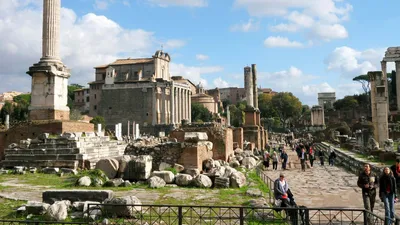
In Rome itself the word forum denoted the flat and formerly marshy space between the Palatine and Capitoline hills (also called forum Romanum), which even during the regal period accommodated such public meetings as could not be held within the area Capitolina. In early times the forum Romanum was used for gladiatorial games, and over the colonnades were galleries for spectators; there were also shops of various kinds. Under the Roman Empire, when the forum became primarily a centre for religious and secular spectacles and ceremonies, it was the site of many of the city’s most imposing temples and monuments. Among the structures surviving in whole or in part are the Temple of Castor and Pollux, the Temple of the Deified Caesar, the Mamertine Prison, the Curia (Senate house), the Temple of Saturn, the Temple of Vesta, the Temple of Romulus, the Arch of Titus, the Arch of Septimius Severus, and the Cloaca Maxima.
Also during the imperial period a considerable number of new forums, the fora civilia (judicial) and venalia (mercantile), came into existence. In addition to the forum Romanum, the forums of Caesar and Augustus belonged to the former class, the forum boarium (cattle), holitorium (vegetable), etc., to the latter.
The 1st-century-BC architect Vitruvius stated that the ideal forum should be large enough to accommodate a large crowd but not so large as to dwarf a small one. He proposed a 3:2 length-to-breadth ratio. It is to this proportion that Trajan’s Forum in Rome was erected early in the 2nd century AD. Commissioned by the emperor Trajan and designed by Apollodorus of Damascus, it measures approximately 920 by 620 feet (about 280 by 190 m) and covers about 25 acres (10 ha). Persons entered through a triple gateway into a colonnaded open space lined with merchants’ booths. The forum is flanked by two semicircular, colonnaded exedrae. Opposite the gateway is the Basilica Ulpia, beyond which is Trajan’s Column, carved with relief sculpture depicting Trajan’s victories. The aesthetic harmony of this space has influenced many subsequent town planners.
Motishon · 3 months ago Published on 2025-11-02 02:10:48 ID NUMBER: 135675
Rabbit
Raccoon
Raccoon Dog
Racer Snake
Radiated Tortoise
Ragamuffin
Ragdoll
Raggle
Rainbow Boa
Rainbow Grasshopper (Dactylotum bicolor)
Rainbow Kribs (Kribensis)
Rainbow Shark
Rat
Rat Snakes
Rat Terrier
Rattlesnake
Red Ackie Monitor
Red Aphids
Red Deer
Red Diamondback Rattlesnake
Red Drum Fish
Red Finch
Red Fox
Red Kite
Red Knee Tarantula
Red Nose Pit Bull
Red Panda
Red Paper Wasp
Red Racer Snake
Red Spitting Cobra
Red Squirrel
Red Star Chicken
Red Tail Boa (common boa)
Red Wolf
Red-Bellied Black Snake
Red-Bellied Woodpecker
Red-Billed Quelea Bird
Red-Eared Slider
Red-Eyed Tree Frog
Red-Footed Tortoise
Red-handed Tamarin
Red-Headed Vulture
Red-Lipped Batfish
Red-Shouldered Hawk
Red-Tailed Cuckoo Bumblebee
Red-winged blackbird
Redback Spider
Redbone Coonhound
Redcap Chicken
Redear Sunfish
Redhump Eartheater
Redstart
Redtail Catfish
Reef Shark
Regal Jumping Spider
Reindeer
Repenomamus
Reticulated python
Rex Rabbit
Rhamphosuchus
Rhea
Rhesus Macaque
Rhino Beetle
Rhino Viper
Rhinoceros
Rhode Island Red Chicken
Rhodesian Ridgeback
Rhombic Egg-Eater Snake
Ribbon Eel
Ribbon Snake
Rim Rock Crowned Snake
Ring-billed Gull
Ringed Kingfisher
Rinkhals Snake
River Otter
River Turtle
Roadrunner
Robber Flies
Robin
Rock Bass
Rock Crab
Rock Hyrax
Rock Python
Rockfish
Rockhopper Penguin
Rodents
Roe Deer
Roosevelt Elk
Rooster
Root Aphids
Rose-Breasted Grosbeak
Roseate Spoonbill
Rosy Boa
Rotterman
Rottle
Rottsky
Rottweiler
Rottweiler Mix
Rough Earth Snake
Rough Green Snake
Rough-Legged Hawk (Rough-Legged Buzzard)
Rove Beetle
Royal Penguin
Rubber Boa
Ruby-Crowned Kinglet
Ruby-Throated Hummingbird
Ruddy Duck
Ruddy Turnstone
Rufous Hummingbird
Russel’s Viper
Russell Terrier
Russian Bear Dog
Russian Blue
Russian Tortoise
Wahoo Fish
Waimanu
Walking Catfish
Wallaby
Walleye Fish
Walrus
Wandering Albatross
Warbler
Warthog
Wasp
Water Beetle
Water Buffalo
Water Bug
Water Dragon
Water Vole
Waterbuck
Wattled Jacana
Wax Moth
Weasel
Weaver Birds: Nature’s Master Architects
Weimaraner
Weimardoodle
Wels Catfish
Welsh Black Cattle
Welsh Corgi
Welsh Springer Spaniel
Welsh Terrier
West Highland Terrier
West Siberian Laika
Western Blacklegged Tick
Western Blind Snake
Western Diamondback Rattlesnake
Western Gorilla
Western Green Mamba
Western Hognose Snake
Western Kingbird
Western Lowland Gorilla
Western Rat Snake
Western Rattlesnake (Northern Pacific Rattlesnake)
Western Tanager
Westiepoo
Whale Shark
Wheaten Terrier
Whimbrel
Whinchat
Whippet
Whiptail Lizard
White Bass
White Butterfly
White Catfish
White Crappie
White Ferret / Albino Ferrets
White German Shepherd
White Marlin
White Rhinoceros
White Shark
White Sturgeon
White Tiger
White-Crowned Sparrow
White-Eyed Vireo
White-Faced Capuchin
White-shouldered House Moth
White-tail deer
White-Tailed Eagle
Whitetail Deer
Whiting
Whoodle
Whooping Crane
Wild Boar
Wildebeest
Willow Flycatcher
Willow Warbler
Winter Moth
Wire Fox Terrier
Wirehaired Pointing Griffon
Wirehaired Vizsla
Wiwaxia
Wolf
Wolf Eel
Wolf Snake
Wolf Spider
Wolffish
Wolverine
Woma Python
Wombat
Wood Bison
Wood Duck
Wood Frog
Wood Tick
Wood Turtle
Woodlouse
Woodlouse Spider
Woodpecker
Woodrat
Wool Carder Bee
Woolly Aphids
Woolly Bear Caterpillar
Woolly Mammoth
Woolly Monkey
Woolly Rhinoceros
Worm
Worm Snake
Wrasse
Writing Spider
Wrought Iron Butterflyfish
Wryneck
Wyandotte Chicken
Wyoming Toad