Motishon · 11 months ago
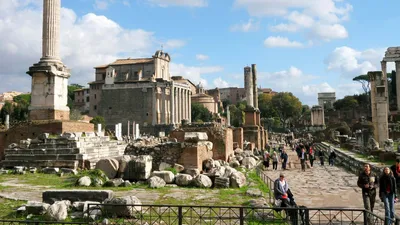
Roman ForumThe Column of Phocas (left foreground) and the Temple of Antoninus and Faustina (left background) among the ruins of the Roman Forum, Rome
In Rome itself the word forum denoted the flat and formerly marshy space between the Palatine and Capitoline hills (also called forum Romanum), which even during the regal period accommodated such public meetings as could not be held within the area Capitolina. In early times the forum Romanum was used for gladiatorial games, and over the colonnades were galleries for spectators; there were also shops of various kinds. Under the Roman Empire, when the forum became primarily a centre for religious and secular spectacles and ceremonies, it was the site of many of the city’s  most imposing temples and monuments. Among the structures surviving in whole or in part are the Temple of Castor and Pollux, the Temple of the Deified Caesar, the Mamertine Prison, the Curia (Senate house), the Temple of Saturn, the Temple of Vesta, the Temple of Romulus, the Arch of Titus, the Arch of Septimius Severus, and the Cloaca Maxima.

Also during the imperial period a considerable number of new forums, the fora civilia (judicial) and venalia (mercantile), came into existence. In addition to the forum Romanum, the forums of Caesar and Augustus belonged to the former class, the forum boarium (cattle), holitorium (vegetable), etc., to the latter.

The 1st-century-BC architect Vitruvius stated that the ideal forum should be large enough to accommodate a large crowd but not so large as to dwarf a small one. He proposed a 3:2 length-to-breadth ratio. It is to this proportion that Trajan’s Forum in Rome was erected early in the 2nd century AD. Commissioned by the emperor Trajan and designed by Apollodorus of Damascus, it measures approximately 920 by 620 feet (about 280 by 190 m) and covers about 25 acres (10 ha). Persons entered through a triple gateway into a colonnaded open space lined with merchants’ booths. The forum is flanked by two semicircular, colonnaded exedrae. Opposite the gateway is the Basilica Ulpia, beyond which is Trajan’s Column, carved with relief sculpture depicting Trajan’s victories. The aesthetic harmony of this space has influenced many subsequent town  planners.