The site tips.wapka.site
T I P S
Albums Category Messages |||
 

Motishon Β· 5 months ago
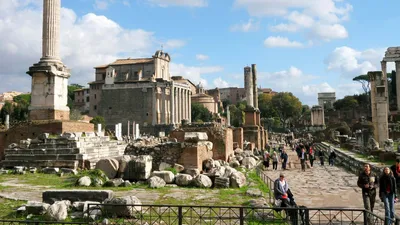
Roman ForumThe Column of Phocas (left foreground) and the Temple of Antoninus and Faustina (left background) among the ruins of the Roman Forum, Rome
In Rome itself the word forum denoted the flat and formerly marshy space between the Palatine and Capitoline hills (also called forum Romanum), which even during the regal period accommodated such public meetings as could not be held within the area Capitolina. In early times the forum Romanum was used for gladiatorial games, and over the colonnades were galleries for spectators; there were also shops of various kinds. Under the Roman Empire, when the forum became primarily a centre for religious and secular spectacles and ceremonies, it was the site of many of the city’s  most imposing temples and monuments. Among the structures surviving in whole or in part are the Temple of Castor and Pollux, the Temple of the Deified Caesar, the Mamertine Prison, the Curia (Senate house), the Temple of Saturn, the Temple of Vesta, the Temple of Romulus, the Arch of Titus, the Arch of Septimius Severus, and the Cloaca Maxima.

Also during the imperial period a considerable number of new forums, the fora civilia (judicial) and venalia (mercantile), came into existence. In addition to the forum Romanum, the forums of Caesar and Augustus belonged to the former class, the forum boarium (cattle), holitorium (vegetable), etc., to the latter.

The 1st-century-BC architect Vitruvius stated that the ideal forum should be large enough to accommodate a large crowd but not so large as to dwarf a small one. He proposed a 3:2 length-to-breadth ratio. It is to this proportion that Trajan’s Forum in Rome was erected early in the 2nd century AD. Commissioned by the emperor Trajan and designed by Apollodorus of Damascus, it measures approximately 920 by 620 feet (about 280 by 190 m) and covers about 25 acres (10 ha). Persons entered through a triple gateway into a colonnaded open space lined with merchants’ booths. The forum is flanked by two semicircular, colonnaded exedrae. Opposite the gateway is the Basilica Ulpia, beyond which is Trajan’s Column, carved with relief sculpture depicting Trajan’s victories. The aesthetic harmony of this space has influenced many subsequent town  planners.
Motishon Β· 5 months ago
Published on 2025-11-02 02:10:48
ID NUMBER: 135675
Forum Public Gathering Place Marketplace and Political Hub Britannica (0)
  • Jadobe Β· 2 months ago

    Fishing cat animal

    The fishing cat (Prionailurus viverrinus) is a medium-sized wild cat of South and Southeast Asia. It has a deep yellowish-grey fur with black lines and spots. Adults have a head-to-body length of 57 to 78 cm (22 to 31 in), with a 20 to 30 cm (8 to 12 in) long tail. Males are larger than females, weighing 8 to 17 kg (18 to 37 lb), while females average 5 to 9 kg (11 to 20 lb). It lives mostly in the vicinity of wetlands, along rivers, streams, oxbow lakes, in swamps  and mangroves where it preys mostly on fish. Other prey items include birds, insects, small rodents, molluscs, reptiles including snakes, amphibians and carrion of cattle. The fishing cat is thought to be primarily nocturnal. It is a good swimmer and can swim long distances, even underwater.

    Jadobe Β· 2 months ago

    European wildcat animal

    The European wildcat (Felis silvestris) is a small wildcat species native to continental Europe, Great Britain, Ireland, Turkey and the Caucasus. Its fur is brownish to grey with stripes on the forehead and on the sides and has a bushy tail with a black tip. It reaches a head-to-body length of up to 65 cm (26 in) with a 34.5 cm (13.6 in) long tail, and weighs up to 7.5 kg (17 lb).

    Jadobe Β· 2 months ago

    Suinae animal

    Suinae is a subfamily of artiodactyl  mammals that includes several of the extant members of Suidae and their closest relatives – the domestic pig and related species, such as babirusas. Several extinct species within the Suidae are classified in subfamilies other than Suinae. However, the classification of the extinct members of the Suoidea – the larger group that includes the Suidae, the peccary family (Tayassuidae), and related extinct species – is controversial, and different classifications vary in the number of subfamilies within Suidae and their contents.[1] Some classifications, such as the one proposed by paleontologist Jan van der Made in 2010, even exclude from Suinae some extant taxa of Suidae, placing these excluded taxa in other subfamilies.[2]

    Jadobe Β· 2 months ago

    Procyonidae animal

    Procyonidae (/ˌproʊsiΛΛˆΙ’nΙͺdiː/ PROH-see-ON-i-dee)[1] is a New World family of the order Carnivora.[2] It includes the raccoons, ringtails, cacomistles, coatis, kinkajous, olingos, and olinguitos. Procyonids inhabit a wide range of environments and are generally omnivorous.

    Jadobe Β· 2 months ago

    Viverridae animals

    Viverridae is a family of small to medium-sized feliform mammals, comprising 14 genera with 33 species. This family was named and first described by John Edward Gray in 1821.[3] Viverrids occur all over Africa, in southern Europe, and in South  and Southeast Asia on both sides of the Wallace Line.[4]

    Jadobe Β· 2 months ago

    Mustelidae animals

    The Mustelidae (/mʌˈstΙ›lΙͺdiː/;[2] from Latin mustela, weasel) are a diverse family of carnivoran mammals, including weasels, badgers, otters, polecats, martens, grisons, and wolverines. Otherwise known as mustelids (/ˈmʌstΙͺlΙͺdz/[3]), they form the largest family in the suborder Caniformia  of the order Carnivora with about 66 to 70 species in nine subfamilies.[4]

    Jadobe Β· 2 months ago

    Leporidae animal

    Leporidae (/lΙ™ΛˆpɔːrΙͺdiː, -daΙͺ/) is the family  of rabbits and hares (Lepus), containing over 70 species of extant mammals in all. Together with the pikas, the Leporidae constitute the mammalian order Lagomorpha. Leporidae differ from pikas in that they have short, furry tails and elongated ears and hind legs.

    Jadobe Β· 2 months ago

    Osteichthyes fish

    Osteichthyes (/ΛŒΙ’stiːˈΙͺkΞΈiːz/ ost-ee-IK-theez; from Ancient Greek ὀστέον (ostΓ©on) 'bone'  and ἰχθύς (ikhthΓΊs) 'fish'),[2] also known as osteichthyans or commonly referred to as the bony fish, is a diverse clade of vertebrate animals that have endoskeletons primarily composed of bone tissue. They can be contrasted with the Chondrichthyes (cartilaginous fish) and the extinct placoderms and acanthodians, which have endoskeletons primarily composed of cartilage. The vast majority of extant fish are members of Osteichthyes, being an extremely diverse and abundant group consisting of 45 orders, over 435 families and 28,000 species.[3]

    Jadobe Β· 2 months ago

    Small sunflower

    Google sunflower
    Tue, Apr 23, 2019 ‒ 2:38 PM
    
    Monday 22 September 2014 06:21 PM  
    
    πŸ—ƒοΈ Small sunflower
    πŸ†” GHKLGHKLDS 

    Jadobe Β· 2 months ago

    Sunflowers a Beautiful and Tasty Addition to Your Landscape

    Google sunflowers 
    Thu, May 18, 2017 ‒ 10:23 PM
    
    Monday 22 September 2014 06:21 PM 
    
    πŸ—ƒοΈ Sunflowers a Beautiful and Tasty Addition to Your Landscape
    πŸ†” GHKLGHKLDS 
     Prev678910Next  
    Premium PS VR2 and Classics (4)
    Funny family quotes that will move you (12)
    Tamil Nadu (Tamilnadu) (8)
    Handloom Sarees (Shareessharis) (8)
    List of Indian independence activists (6)
    Colored yarn Salgara Udaipur Gomati Tripura 2025 (3)
    Secret information of Akkach Miah (1)
    Bangla rhymes and poems (4)
    Four Major Festivals (4)
    Top Beautiful Villages Around the World That Feel Like a Fairytale (12)
     Prev16171819202122...63Next  


    Albums Category Members Messages
    Login
    HELP CENTER :-: GO TO TOP
    tips.wapka.site
    Copyright Β© 2026 All Rights Reserved
    Powered by wapka.org