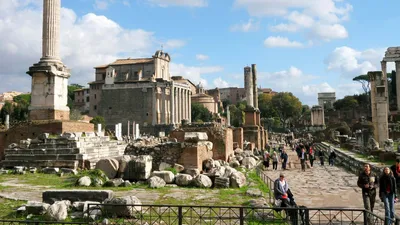
In Rome itself the word forum denoted the flat and formerly marshy space between the Palatine and Capitoline hills (also called forum Romanum), which even during the regal period accommodated such public meetings as could not be held within the area Capitolina. In early times the forum Romanum was used for gladiatorial games, and over the colonnades were galleries for spectators; there were also shops of various kinds. Under the Roman Empire, when the forum became primarily a centre for religious and secular spectacles and ceremonies, it was the site of many of the city’s most imposing temples and monuments. Among the structures surviving in whole or in part are the Temple of Castor and Pollux, the Temple of the Deified Caesar, the Mamertine Prison, the Curia (Senate house), the Temple of Saturn, the Temple of Vesta, the Temple of Romulus, the Arch of Titus, the Arch of Septimius Severus, and the Cloaca Maxima. Also during the imperial period a considerable number of new forums, the fora civilia (judicial) and venalia (mercantile), came into existence. In addition to the forum Romanum, the forums of Caesar and Augustus belonged to the former class, the forum boarium (cattle), holitorium (vegetable), etc., to the latter. The 1st-century-BC architect Vitruvius stated that the ideal forum should be large enough to accommodate a large crowd but not so large as to dwarf a small one. He proposed a 3:2 length-to-breadth ratio. It is to this proportion that Trajan’s Forum in Rome was erected early in the 2nd century AD. Commissioned by the emperor Trajan and designed by Apollodorus of Damascus, it measures approximately 920 by 620 feet (about 280 by 190 m) and covers about 25 acres (10 ha). Persons entered through a triple gateway into a colonnaded open space lined with merchants’ booths. The forum is flanked by two semicircular, colonnaded exedrae. Opposite the gateway is the Basilica Ulpia, beyond which is Trajan’s Column, carved with relief sculpture depicting Trajan’s victories. The aesthetic harmony of this space has influenced many subsequent town planners.
Jadobe · 3 months ago
Hybrid (biology)
In biology, a hybrid is the offspring resulting from combining the qualities of two organisms of different varieties, subspecies, species or genera through sexual reproduction. Generally, it means that each cell has genetic material from two different organisms, whereas an individual where some cells are derived from a different organism is called a chimera.[1] Hybrids are not always intermediates between their parents such as in blending inheritance (a now discredited theory in modern genetics by particulate inheritance), but can show hybrid vigor, sometimes growing larger or taller than either parent. The concept of a hybrid is interpreted differently in animal and plant breeding, where there is interest in the individual parentage. In genetics, attention is focused on the numbers of chromosomes. In taxonomy, a key question is how closely related the parent species are.[clarification needed] |
Jadobe · 3 months ago
The donkey or ass is a domesticated equine.
The donkey or ass is a domesticated equine. It derives from the African wild ass, Equus africanus, and may be classified either as a subspecies thereof, Equus africanus asinus, or as a separate species, Equus asinus.[1]: 1 It was domesticated in Africa some 5000–7000 years ago,[1]: 2 [2]: 3715 [3] and has been used mainly as a working animal since that time. |
Jadobe · 3 months ago
Zonkey (Tijuana)
Zonkeys in Tijuana, Mexico are donkeys (also known as burros in Mexico and the Southwestern United States; burro is the Spanish word for donkey) painted with fake zebra stripes, so that tourists will pay the owner to appear in souvenir photos with them.[1] They should not be confused with zebroids, zebra hybrids which are also sometimes called zonkeys. |
Jadobe · 3 months ago
Als Zebroide werden Hybriden innerhalb der Gattung Pferde aus Kreuzungen zwischen einem Zebra und einer anderen Pferdeart bezeichnet
Als Zebroide werden Hybriden innerhalb der Gattung Pferde aus Kreuzungen zwischen einem Zebra und einer anderen Pferdeart bezeichnet. Aus praktischen Gründen (einfachere Aufzucht) wird dabei als Vater meist ein Zebra verwendet. Wie die meisten Hybriden aus verschiedenen Arten, wie Maultiere und Maulesel, sind auch Zebroide meist nicht fortpflanzungsfähig. |
Jadobe · 3 months ago
A zebroid is the offspring of any cross between a zebra and any other equine to create a hybrid
A zebroid is the offspring of any cross between a zebra and any other equine to create a hybrid. In most cases, the sire is a zebra stallion but not every time. The offspring of a donkey sire and zebra dam, called a donkra, and the offspring of a horse sire and a zebra dam, called a hebra, do exist, but are rare and are usually sterile. Zebroids have been bred since the 19th century. Charles Darwin noted several zebra hybrids in his works.[1] |
Prev678910Next
Prev11121314151617...64Next