The site tips.wapka.site
T I P S
Albums Category Messages |||
Motishon Β· 3 months ago
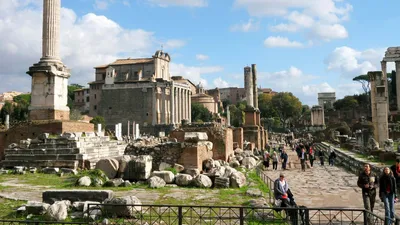
Roman ForumThe Column of Phocas (left foreground) and the Temple of Antoninus and Faustina (left background) among the ruins of the Roman Forum, Rome
In Rome itself the word forum denoted the flat and formerly marshy space between the Palatine and Capitoline hills (also called forum Romanum), which even during the regal period accommodated such public meetings as could not be held within the area Capitolina. In early times the forum Romanum was used for gladiatorial games, and over the colonnades were galleries for spectators; there were also shops of various kinds. Under the Roman Empire, when the forum became primarily a centre for religious and secular spectacles and ceremonies, it was the site of many of the city’s  most imposing temples and monuments. Among the structures surviving in whole or in part are the Temple of Castor and Pollux, the Temple of the Deified Caesar, the Mamertine Prison, the Curia (Senate house), the Temple of Saturn, the Temple of Vesta, the Temple of Romulus, the Arch of Titus, the Arch of Septimius Severus, and the Cloaca Maxima.

Also during the imperial period a considerable number of new forums, the fora civilia (judicial) and venalia (mercantile), came into existence. In addition to the forum Romanum, the forums of Caesar and Augustus belonged to the former class, the forum boarium (cattle), holitorium (vegetable), etc., to the latter.

The 1st-century-BC architect Vitruvius stated that the ideal forum should be large enough to accommodate a large crowd but not so large as to dwarf a small one. He proposed a 3:2 length-to-breadth ratio. It is to this proportion that Trajan’s Forum in Rome was erected early in the 2nd century AD. Commissioned by the emperor Trajan and designed by Apollodorus of Damascus, it measures approximately 920 by 620 feet (about 280 by 190 m) and covers about 25 acres (10 ha). Persons entered through a triple gateway into a colonnaded open space lined with merchants’ booths. The forum is flanked by two semicircular, colonnaded exedrae. Opposite the gateway is the Basilica Ulpia, beyond which is Trajan’s Column, carved with relief sculpture depicting Trajan’s victories. The aesthetic harmony of this space has influenced many subsequent town  planners.
Motishon Β· 3 months ago
Published on 2025-11-02 02:10:48
ID NUMBER: 135675
Forum Public Gathering Place Marketplace and Political Hub Britannica (0)

Edit Report Send Share
Motishon Β· 3 months ago
Trajan's Forum Trajan's Forum, Rome; designed by Apollodorus of Damascus.
forum, in Roman cities in antiquity, multipurpose, centrally located open area that was surrounded by public buildings and colonnades and that served as a public gathering place. It was an orderly spatial adaptation of the Greek agora, or marketplace, and acropolis.

In the laws of the Twelve Tables the word is used for the vestibule of a tomb; in a Roman camp the forum was an open place beside the praetorium, and the term was originally applied generally to the space in front of any public building  or gateway.
Motishon Β· 3 months ago
Roman ForumThe Column of Phocas (left foreground) and the Temple of Antoninus and Faustina (left background) among the ruins of the Roman Forum, Rome
In Rome itself the word forum denoted the flat and formerly marshy space between the Palatine and Capitoline hills (also called forum Romanum), which even during the regal period accommodated such public meetings as could not be held within the area Capitolina. In early times the forum Romanum was used for gladiatorial games, and over the colonnades were galleries for spectators; there were also shops of various kinds. Under the Roman Empire, when the forum became primarily a centre for religious and secular spectacles and ceremonies, it was the site of many of the city’s  most imposing temples and monuments. Among the structures surviving in whole or in part are the Temple of Castor and Pollux, the Temple of the Deified Caesar, the Mamertine Prison, the Curia (Senate house), the Temple of Saturn, the Temple of Vesta, the Temple of Romulus, the Arch of Titus, the Arch of Septimius Severus, and the Cloaca Maxima.

Also during the imperial period a considerable number of new forums, the fora civilia (judicial) and venalia (mercantile), came into existence. In addition to the forum Romanum, the forums of Caesar and Augustus belonged to the former class, the forum boarium (cattle), holitorium (vegetable), etc., to the latter.

The 1st-century-BC architect Vitruvius stated that the ideal forum should be large enough to accommodate a large crowd but not so large as to dwarf a small one. He proposed a 3:2 length-to-breadth ratio. It is to this proportion that Trajan’s Forum in Rome was erected early in the 2nd century AD. Commissioned by the emperor Trajan and designed by Apollodorus of Damascus, it measures approximately 920 by 620 feet (about 280 by 190 m) and covers about 25 acres (10 ha). Persons entered through a triple gateway into a colonnaded open space lined with merchants’ booths. The forum is flanked by two semicircular, colonnaded exedrae. Opposite the gateway is the Basilica Ulpia, beyond which is Trajan’s Column, carved with relief sculpture depicting Trajan’s victories. The aesthetic harmony of this space has influenced many subsequent town  planners.
Motishon Β· 3 months ago
Pompeii, Italy: ForumThe ruins of the Forum at Pompeii, Italy, with Mount Vesuvius in the distance
The forum was generally paved, and, although on festal occasions chariots were driven through, it was not a thoroughfare and was enclosed by gates at the entrances, of which traces have been found at Pompeii.
Jadobe Β· 6 minutes ago
Society finch
The Society finch (Lonchura striata domestica), also known as the Bengali finch  or Bengalese finch, is a domesticated subspecies of estrildid finch. It became a popular cage and trade bird after appearing in European zoos in the 1860s through being imported from Japan, though it was domesticated in China. Coloration and behavior were modified through centuries of selection in Asia, then later in Europe and North America.[1]
Jadobe Β· 10 minutes ago
Double-barred finch
The double-barred finch (Stizoptera bichenovii) is an estrildid finch found in dry savannah, tropical (lowland) dry grassland and shrubland habitats in northern and eastern Australia. It is sometimes referred to as Bicheno's finch or as the owl finch, the latter of which owing to the dark ring of feathers around the face. It is the only species placed in the genus Stizoptera .
Jadobe Β· 12 minutes ago
Red-browed finch
The red-browed finch (Neochmia temporalis) is an estrildid finch that inhabits the east coast of Australia. This species has also been introduced to French Polynesia. It is commonly found in temperate forest and dry savannah habitats. It may also be found in dry forest and mangrove habitats in tropical regions.
Jadobe Β· 13 minutes ago
Sunda zebra finch
The Sunda zebra finch (Taeniopygia guttata) is a species of bird in the family Estrildidae. It is found in the Lesser Sundas.
Jadobe Β· 15 minutes ago
The zebra finch
The zebra finches are two species of estrildid finch in the genus Taeniopygia found in Australia and Indonesia. They are seed-eaters that travel in large flocks.
Jadobe Β· 17 minutes ago
Australian zebra finch
The Australian zebra finch (Taeniopygia castanotis)[2] is the most common estrildid finch of Central Australia. It ranges over most of the continent, avoiding only the cool humid south and some areas of the tropical far north. The bird has been introduced to Puerto Rico and Portugal.[1] Due to the ease of keeping and breeding the zebra finch in captivity, it has become Australia's most widely studied bird; by 2010, it was the most studied captive model passerine species worldwide, by a considerable margin.[3]
Jadobe Β· 1 hour ago
Vitta zebra
Vitta zebra, commonly known as the zebra nerite, is a species of sea snail, a marine gastropod mollusk in the family Neritidae.[
Jadobe Β· 1 hour ago
Sagittunio nasutus in wiki
Sagittunio nasutus, the eastern pondmussel, is a species of freshwater mussel in the family Unionidae, the river mussels.[
Jadobe Β· 2 hours ago
Blue mussel
The blue mussel (Mytilus edulis), also known as the common mussel,[1] is a medium-sized edible marine bivalve mollusc in the family Mytilidae, the only extant family in the order  Mytilida, known as "true mussels". Blue mussels are subject to commercial use and intensive aquaculture. A species with a large range, the blue mussel leaves empty shells that are commonly found on beaches around the world.
Jadobe Β· 2 hours ago
Family of freshwater mussels
The Unionidae are a family of freshwater mussels, the largest in the order Unionida, the bivalve molluscs sometimes known as river mussels, or simply as unionids.[1][2]
Meski Β· 1 year ago
UC Browser 13.2.0.1296 (com.UCMobile.intl)


Jadobe - Author
Junaki - Author
Falaki - Author
Fanta - Author
Atalii - Author
Manoo - Author
Salpon - Author
Simran - Author
Billkis - Author
Seran - Author
 Prev1234...10Next  
Zebra Finch (6)
Zebra Mussels (8)
Zebra Pleco (10)
Zebra Shark (3)
Zebra Spitting Cobra (3)
Zebrafish (4)
Zebu (7)
Zokor (4)
Zonkey (4)
Zorse (5)
 Prev1234...62Next  
Browsers (1)
Albums Category Members Messages
Login
HELP CENTER :-: GO TO TOP
tips.wapka.site
Copyright Β© 2026 All Rights Reserved
Powered by wapka.org