The blogger tips.wapka.site
โ˜ฐ T  I  P  S 
Total (632)
 Prev6061626364Next  

Eskam ยท 1 year ago

Longfin African Conger (Conger cinereus)

The Longfin African conger lives in the Indo-Pacific oceans, from the Red Sea and East Africa to the Marquesas and Easter Islands. They can survive depths of 262 feet, growing up to 4.3 feet long.

This type of eel feeds on small fish and crustaceans. It has an elongated body and fin extending from just behind the head to the tip of the tail, earning it the name 'Longfin.'

Eskam ยท 1 year ago

Snowflake Moray Eel (Echidna nebulosa)

The Snowflake Moray Eel has a distinctive pattern of black splotches resembling snowflakes. It is a relatively small eel, typically up to 24 inches long. They live in the tropical Indo-Pacific region, among coral reefs and rock formations in warm summer waters.

The nocturnal Snowflake Moray Eel spends the day in reef crevices to avoid the sun. It is skilled enough to navigate its underwater labyrinth and hunt for food at night. Moreover, its long, flexible body allows it to probe into narrow corners and crevices, looking for small fish and crustaceans.

The Snowflake Moray Eel is peaceful when not on the hunt, attracting aquarium owners worldwide.

Eskam ยท 1 year ago

Green Moray Eel (Gymnothorax funebris)

The Green Moray Eel inhabits the deep, shadowy waters of the western Atlantic Ocean. Green Moray Eels can grow up to 7.2 feet long and weigh approximately 64 lbs.

Despite its name, this species is not green, but its natural color is soft brown with a layer of yellow mucus. When hit by light, this mucus gives the appearance of vibrant green. 

These types of eels periodically open and close their mouths because their gills require a continuous flow of water for breathing. They eat mainly fish, squids, and crabs. Lastly, they hide in dark crevices of coral reefs or rocky underwater terrains during the day and come out at night to hunt.

Eskam ยท 1 year ago

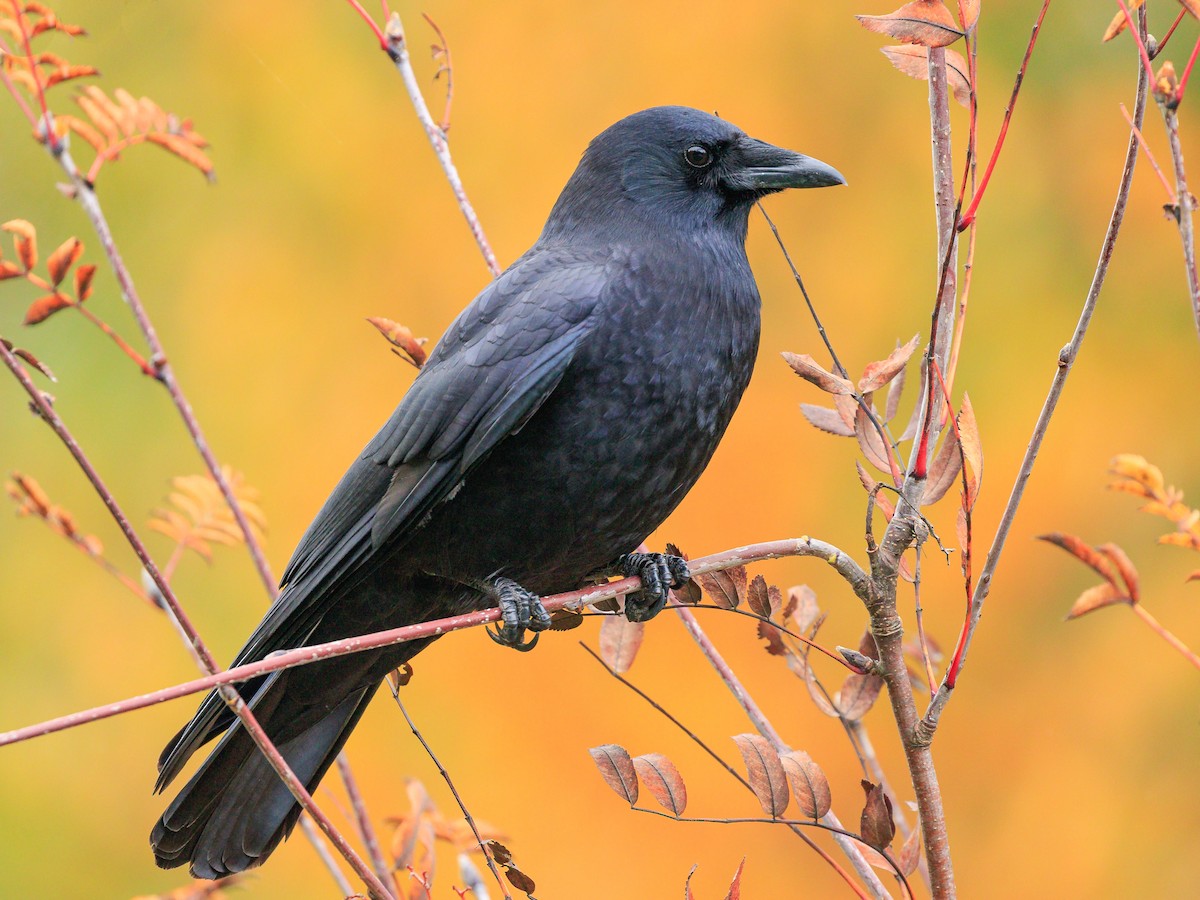
American Crow (Corvus brachyrhynchos)

American Crows are approximately 16-21 inches long, showcasing an iridescent, uniform black color. These daring birds in North America adapt comfortably to open habitats, flourishing in farmlands, forests, and cities.

Their diets are notably diverse, scavenging on grains, fruits, insects, small animals, carrion, and human food waste. Scientists have also observed them modifying wood and using it to probe a small hole where a spider lives.

Regarding parenting, the Corvidae family is practicing cooperative breeding. In the 1980s, Lawrence Kilham first observed adult and yearling American Crows take turns in parenting. Young crows can stay with their parents for five years or longer1.

Moreover, the West Nile Virus has impacted their numbers by 45% since 1999. Fortunately, thanks to their resilience, they are still a species of least concern.

Eskam ยท 1 year ago

Northwestern Crow (Corvus caurinus)

The Northwestern Crow stands around 17 inches tall, slightly smaller than the common crow. This type of crow nests primarily along the coasts of the northeastern Pacific Ocean, predominantly in forested areas near rivers.

Interestingly, the diet of this coastal crow differs slightly from that of its relatives. Aside from the typical crow menu, it forages along the shoreline to feed on clams, crustaceans, and sea urchins, employing different tactics to open them up.

Eskam ยท 1 year ago

Hooded Crow (Corvus cornix)

The Hooded Crow or Scald Crow showcases a combination of grey and black body coloring. On average, this crow grows up to 20 inches in length. 

It's often spotted in northern and eastern Europe and parts of the Middle East. They display a preference for woodland, farmland, and urban areas. Like the Carrion Crow, they are constantly scavenging but feed on mollusks, small mammals, nuts, etc.

Eskam ยท 1 year ago

Collared Crow (Corvus torquatus)

The Collared Crow, distinguished by the white collar marking on its neck and chest, is significantly larger than most crow species, usually measuring up to 22 inches long. 

Typically found in China and Vietnam, the Collared Crow thrives in open habitats such as fields and wetlands. Its diet mainly consists of grains, seeds, insects, mollusks, and occasionally easily accessible eggs and carrion when food is scarce. 

In 2018, IUCN declared them as vulnerable species because of agricultural intensification that kills most of their prey and direct persecution by humans2.

Eskam ยท 1 year ago

White-necked Crow (Corvus leucognaphalus)

The White-necked Crow is distinguished by its black plumage, except for a patch of white stretching from its throat to its chest. The lighter hue is hidden since it only occurs on the base of their neck feathers, which are rarely seen.

Roughly the size of a small raven, it measures about 17 to 18 inches long. It boasts a large, slightly curved bill and red iris. 

This species primarily dwells in forests and woodlands across specific regions of the Caribbean, notably Haiti and the Dominican Republic. Due to agricultural conversion, hunting, and pest control, this type of crow is already extinct in Puerto Rico. Overall, White-necked Crows are considered vulnerable species by the IUCN.

Eskam ยท 1 year ago

Grey Crow (Corvus tristis)

The Grey Crow, also known as the Bare-faced Crow, sports a predominantly black plumage with a noticeable light grey patch at its neck and underside. It also has a bare, pinkish face and blue eyes. It measures 16-18 inches in length, similar to a medium-sized raptor. 

Primarily found in New Guinea and some nearby islands, this crow species thrives in many habitats, from coastal areas to mountain forests. Their diet is varied: fruits, seeds, and small animals.

Eskam ยท 1 year ago

Carrion Crow (Corvus corone)

The Carrion Crow stands around 19-20 inches tall, boasting an all-black appearance that extends to their strong, stout bill and legs. Their glossy plumage exhibits hints of green and purple sheen. 

You'd commonly find Carrion Crows stretching from Scandinavia to Spain across Western Europe. They adapt to numerous environments, from forests and fields to town centers.

As a predatory bird, their diet mainly comprises carrion, although they also eat insects, worms, fruits, and seeds. They also steal eggs and catch from other birds.
 Prev290291292293294295296...601Next  
Blogger Files Members Messages
Tips
Login
HELP CENTER :-: GO TO TOP
tips.wapka.site
Copyright ยฉ 2026 All Rights Reserved
Powered by wapka.org